I hope each of you had a magical, exciting first day back to school with students. One of the first steps in teaching English learners is building a relationship that ensures trust and safety between the students, schools, and families. Establishing culturally rich classrooms for all of our students is a great place to start. As a country, we have become an anti-immigrant society and our students often sense that tension. The term English learner doesn’t automatically mean that our students are “undocumented immigrants” most of our English learner population actually are US born and raised. Building culturally responsive classrooms is the best place to start changing this mindset.
As educators we are all tasked with assuming responsibility for the education of English learners. Helping these students succeed is the job of all teachers – not just the ESOL teacher. Learning social language comes naturally but learning academic language can be a challenging feat. English learners are developing literacy skills in each content area in their second language as the simultaneously learn, comprehend, and apply content area concepts through their second language (TESOL, 2018). They are doing double the work: learning English and learning content but they don’t have the luxury of double the time. It is critical that English learners maximize the time learning both English and content and that can only happen when we, as their teachers, target both areas through content and language objectives. (More about this to come in a future blog)
To build culturally responsive classrooms we can:
- respect, affirm, and promote students’ home languages and cultural knowledge and experiences as resources;
- celebrate multilingualism and diversity
- help prepare students to be global citizens
Our goal is not to force English on them and cause them to lose literacy in their native language but to learn English while having opportunities to maintain and further develop their own language and be a part of a community that respects all cultures.
Throughout this year, I will share strategies with you from a wonderful resource The 6 Principles for Exemplary Teaching of English learners: Grades K-12 written by TESOL Press. These principles are not new concepts but build on the findings of several decades of research on second language acquisition and language teaching (TESOL, 2018). I hope you find this information helpful in your classroom and take away information and strategies that you can use to teach language through content. I also hope you will take a peak at these principles and take a few minutes to watch the video below. #LoveFirstTeachSecond
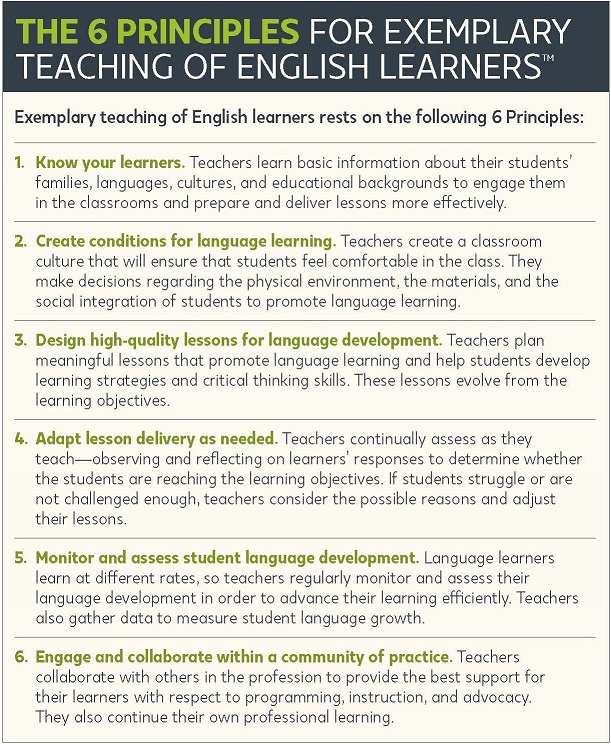
TESOL International Association (TESOL). 2018. The 6 principles for exemplary teaching of English learners: Grades K-12. Alexandria, VA: Author.

 English Learners in Laurens County